Indoor Outdoor Tile Transitions: How to Create a Seamless Flow | Quartile India
Struggling with indoor outdoor tile transitions? Learn how to achieve level alignment, slip resistance, and visual continuity between your home and patio.
There's a particular kind of disappointment that comes from stepping through a beautiful sliding door onto a patio that suddenly feels like a completely different house. A visible step down, a jarring change in tile colour, or an awkward threshold strip can undo the effect of even the most carefully designed interior. Getting indoor outdoor tile transitions right is one of those details that homeowners rarely notice when it's done well, but instantly clock when it isn't.
This guide walks through what actually makes these transitions work, from choosing the right materials to solving the practical challenges of level changes and slope, so your home flows as effortlessly outside as it does within.
Why Indoor Outdoor Tile Transitions Matter So Much
A seamless transition does more than look good in photographs. It genuinely changes how a home feels day to day, making indoor and outdoor spaces feel like extensions of one another rather than separate zones divided by a hard line. This matters especially in villa living, where expansive glass doors and open-plan layouts are designed specifically to blur the boundary between inside and out.
Visual continuity, achieved through matching or complementary stone tones and consistent tile sizing, is often what makes the biggest difference here. When the flooring reads as one continuous surface, the eye doesn't register a stopping point, and the space simply feels larger and more connected.
Why Indoor Outdoor Transitions Fail Alignment-Wise
Level Alignment Challenges
The most common reason a transition feels disjointed comes down to level alignment. Indoor floors and outdoor patios are rarely built at exactly the same height by default, since outdoor surfaces typically need a slight slope for drainage and are often constructed with different subfloor systems entirely. When these two surfaces meet without careful planning, you end up with a noticeable step, an uneven threshold, or a trip hazard right at the doorway.
Getting this right requires coordination early in the design or renovation process, ideally before flooring is installed on either side, so that finished heights can be planned to meet as closely and safely as possible.
Indoor Outdoor Tile Transitions When Patio Slope Varies
Outdoor spaces almost always incorporate some degree of slope to direct rainwater away from the home, which complicates achieving a perfectly flat, continuous surface. The solution usually involves a carefully calculated threshold detail, sometimes a slim recessed drain channel right at the doorway, that absorbs the slope transition without creating a visible or awkward step. A skilled installer accounts for this slope from the outset rather than trying to correct for it after tiles are already down.
Porcelain vs Natural Stone for Indoor Outdoor Flow
Choosing the right material is just as important as solving the technical alignment challenges.
| Factor | Porcelain | Natural Stone |
|---|---|---|
| Consistency | Highly uniform | Natural variation |
| Slip resistance | Available in textured outdoor grades | Naturally textured options available |
| Weather resistance | Excellent | Good, varies by stone type |
| Indoor-outdoor matching | Easier to match precisely | More organic, harder to match exactly |
| Aesthetic | Clean, contemporary | Warm, natural character |
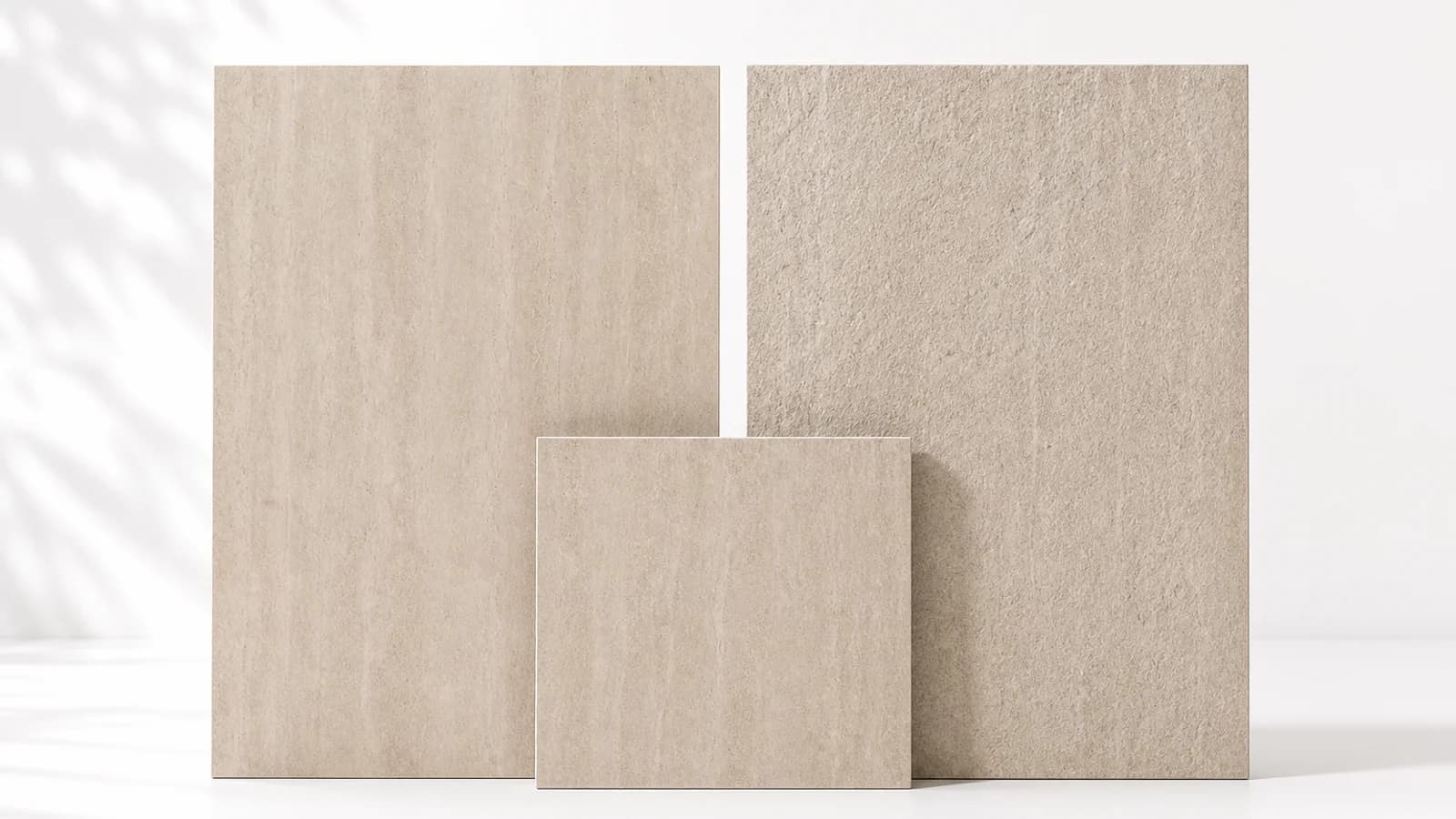
Porcelain has become a popular choice for indoor outdoor transitions specifically because manufacturers now produce matching indoor and outdoor lines in the same colour and pattern, with the outdoor version simply featuring a textured, slip-resistant finish. This makes achieving true visual continuity considerably easier than trying to match two different natural stone varieties.
Natural stone still holds strong appeal for its authentic character, and with the right sourcing, matching indoor and outdoor stone tones is entirely achievable, just with a bit more careful selection involved compared to a manufactured porcelain range.
How to Match Stone Finish Indoors and Outdoors
Achieving a cohesive look across the threshold comes down to a few deliberate choices:
- Choose the same stone family for both zones, even if the outdoor version has a different surface texture for slip resistance.
- Match tile size and grout width as closely as possible, since inconsistent proportions break the illusion of continuity even when colours align.
- Coordinate finish tone carefully, since a polished indoor floor next to a textured outdoor one can look mismatched if the underlying colour isn't nearly identical.
- Test samples in actual lighting conditions, since indoor and outdoor lighting can make the same stone appear quite different in tone.
Stone Flooring Using Large Format Across the Threshold
Large format tiles have become especially popular for indoor outdoor transitions, and for good reason. Fewer grout lines across a bigger surface area means fewer visual interruptions right at the point where indoor and outdoor flooring meet. Large format tiles used consistently on both sides of a threshold create a genuinely seamless look, with the transition line becoming almost invisible rather than a jarring change in pattern density.
This approach works particularly well with sliding or pocket doors that disappear fully into the wall, since there's minimal framing left to interrupt the visual flow between the two large format surfaces.
Indoor Outdoor Transitions Using Continuous Cladding
Beyond flooring, stone cladding can extend the sense of continuity vertically as well. Carrying the same cladding material from an interior feature wall out onto an exterior wall near the threshold reinforces the connection between spaces, making the transition feel intentional rather than incidental. This approach works especially well in villa living, where a bold stone cladding treatment often anchors both an indoor living area and an adjoining outdoor lounge or veranda.
Indoor Outdoor Tile Transitions When Slip Resistance Is Needed
Balancing Style with Safety
Outdoor surfaces inevitably face rain, dew, and general moisture exposure that indoor floors rarely encounter, which makes slip resistance a non-negotiable factor for the exterior side of any transition. The challenge lies in choosing an outdoor tile textured enough for genuine grip, while still closely matching the tone and character of the smoother indoor surface beside it.
Fortunately, most quality stone and porcelain ranges now offer coordinated indoor and outdoor finishes specifically designed to solve this problem, pairing a polished or honed indoor tile with a textured outdoor counterpart in a matching or complementary tone. This lets you maintain visual continuity without compromising on safety where it matters most.
Indoor Outdoor Tile Transitions for Villa Living
Villas, with their typically expansive glass doors and layouts designed around indoor-outdoor living, benefit enormously from getting this detail right. A well-executed transition transforms a villa's ground floor into one continuous experience, living room flowing into veranda, veranda flowing into garden, rather than a series of disconnected rooms with hard stops between them.
Investing extra planning time into level alignment, material matching, and slip resistance at these thresholds pays off considerably in how expansive and considered the finished home feels.
FAQ
Frequently Asked Questions
Common questions about this topic from the Quartile team.
Differences in tile size, grout width, finish tone, or level alignment are the most common culprits behind a transition that feels disconnected rather than seamless.
Tags