Granite vs Quartzite Countertop Durability: Complete Guide by Quartile India
Trying to decide between granite and quartzite for your kitchen? This complete guide breaks down granite vs quartzite countertop durability so you can choose with confidence.
Standing in a stone yard staring at two equally stunning slabs, one labeled granite and one labeled quartzite, it's easy to assume they're interchangeable. They're not. While both are natural stones prized for kitchen countertops, they behave quite differently once daily cooking, hot pans, and the occasional dropped knife enter the picture.
If you're trying to settle the granite vs quartzite countertop durability question once and for all, you need more than a glance at color and pattern. You need to understand how each stone forms, how it handles scratches and stains, and which one actually suits the way you use your kitchen. This guide walks you through all of it.
What Sets Granite and Quartzite Apart
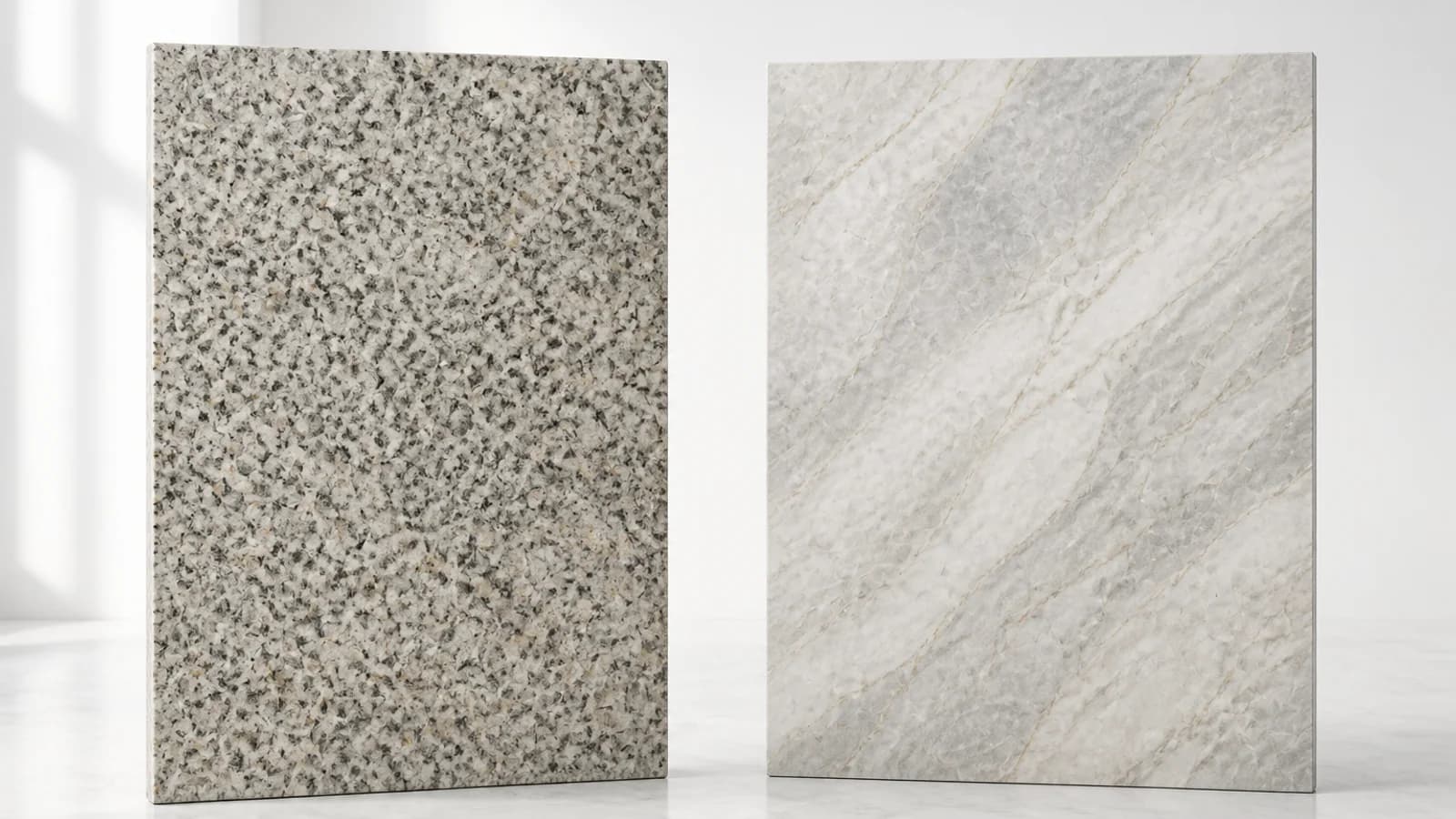
Granite is an igneous rock formed from cooled magma, packed with interlocking crystals of quartz, feldspar, and mica. That crystalline structure is what gives granite its speckled, granular look and its reputation as a tough, dependable countertop material.
Quartzite starts life as sandstone, then undergoes intense heat and pressure deep within the earth until it recrystallizes into a dense, tightly bonded stone. This metamorphic process is also why quartzite is often mistaken for quartz, even though the two have almost nothing in common. Quartz is an engineered material made from crushed stone and resin, while quartzite is entirely natural.
Both stones are beautiful and durable, but their formation process directly shapes how they perform on scratch resistance, porosity, and long-term wear.
Hardness and Scratch Resistance
Is Quartzite Harder Than Granite for Kitchen Countertops?
On the Mohs hardness scale, quartzite generally sits at the harder end, often rivaling or exceeding the quartzite hardness rating of many granite varieties. This makes quartzite one of the toughest natural stones available for kitchen use, standing up exceptionally well to knives, pots, and everyday kitchen tools.
Granite isn't far behind, though. It's still considerably harder than many other countertop materials, and for most households, the difference in day-to-day scratch resistance is barely noticeable.
Granite vs Quartzite: Which Scratches Less in Daily Use?
In real kitchens, both stones resist scratching well enough that you shouldn't worry about a wine glass or dinner plate leaving a mark. Where they diverge is under more determined abuse, chopping directly on the surface or dragging cast iron across it repeatedly. Quartzite edges ahead here thanks to its density, but granite remains a dependable performer that rarely disappoints in typical use.
| Factor | Granite | Quartzite |
|---|---|---|
| Hardness | Very hard | Extremely hard |
| Scratch resistance | Excellent | Outstanding |
| Formation | Igneous (cooled magma) | Metamorphic (heat-pressed sandstone) |
| Appearance | Granular, speckled | Often marble-like veining |
| Best suited for | Everyday kitchens | Heavy-use and statement kitchens |
Porosity and Stain Resistance
Granite Porosity Comparison
Granite is naturally porous, though the degree varies from slab to slab depending on mineral composition. This porosity means granite can absorb liquids like oil, wine, or coffee if left unsealed, which is why regular sealing is a non-negotiable part of granite ownership.
Granite vs Quartzite Stain Resistance Comparison
Quartzite tends to be denser and less porous than granite, giving it a natural edge in stain resistance once properly sealed. That said, quartzite still requires sealing to perform at its best, since its porosity, while generally lower, isn't zero. Neither stone is stain-proof straight out of the quarry; both rely on a good sealant and reasonably prompt cleanup to stay pristine.
Expert Note: A properly sealed quartzite countertop typically resists everyday staining better than an equally sealed granite counter, but the gap narrows considerably with consistent maintenance on either stone.
Stone Surface Wear Patterns Over Time
How a countertop ages matters as much as how it performs on day one. Stone surface wear patterns differ noticeably between the two materials over years of use.
Granite tends to develop a slightly duller finish in high-contact areas if sealing lapses, along with occasional micro-etching near sinks or stovetops from acidic spills. Quartzite generally holds its polish and edge definition longer, thanks to its hardness and density, though it isn't entirely immune to etching from strong acids either.
Neither stone shows dramatic wear under normal household use. The differences tend to show up only after years of heavy cooking, frequent acidic spills, or inconsistent sealing habits.
Maintenance Requirements Compared
Quartzite Countertop Maintenance vs Granite Long Term
Both stones need similar care routines: periodic sealing, prompt cleanup of spills, and avoiding harsh abrasive cleaners. The real difference lies in frequency and forgiveness.
- Granite: Needs consistent resealing to maintain stain resistance, since its higher porosity makes lapses more noticeable.
- Quartzite: Also needs sealing, but its lower porosity tends to be more forgiving if a resealing cycle runs slightly late.
Neither stone is high-maintenance in the way people sometimes assume. A simple routine of pH-neutral cleaning and periodic sealing keeps both looking their best for years.
Best Natural Stone Countertop for Heavy Cooking Kitchens
If your kitchen sees constant use, think daily meal prep, frequent entertaining, or a household that genuinely cooks rather than just reheats, quartzite often makes more sense. Its superior hardness and stain resistance hold up better to the wear and tear of a busy kitchen.
Granite remains an excellent choice too, particularly for households with moderate cooking habits and a preference for its classic, speckled aesthetic. It's also typically more budget-friendly, which matters when outfitting a large kitchen.
Granite vs Quartzite Cost Difference in India
Granite is widely quarried across India, which generally keeps it more accessible and affordable compared to quartzite, much of which is imported or sourced from a smaller number of domestic locations. Quartzite's rarity, combined with its density making it harder to cut and finish, typically pushes its price higher. If budget is a primary concern, granite often delivers excellent durability at a more approachable price point, while quartzite suits buyers prioritizing a specific look or maximum performance.
Granite vs Quartzite for Outdoor Kitchen Countertops
Outdoor spaces bring extra challenges: direct sun, temperature swings, and constant exposure to the elements. Quartzite generally performs better outdoors thanks to its density and resistance to UV fading, holding its color and finish more consistently over time. Granite can also work well outdoors, but it benefits from a higher-quality sealant and more frequent maintenance checks to prevent moisture-related issues in exposed settings.
Making the Right Choice for Your Kitchen
There's no universally "better" stone here, only a better fit for your specific kitchen and habits.
- Choose granite if you want proven durability, a wide range of budget-friendly options, and a classic speckled look.
- Choose quartzite if you want maximum hardness, superior stain resistance, and a marble-like appearance without marble's higher maintenance needs.
Both stones, when properly sealed and cared for, will serve your kitchen well for decades.
FAQ
Frequently Asked Questions
Common questions about this topic from the Quartile team.
Yes, in most cases. Quartzite generally ranks higher on the hardness scale, though granite remains highly durable for everyday kitchen use.
Tags